- The Vandalist Academy
- Posts
- What a Razor Burn Taught Me About Film Pitching
What a Razor Burn Taught Me About Film Pitching
How I pitched a 2.5-hour Zoom call while sick, bleeding, and covered in makeup

Thomas Percy Kim
January 27, 2026
This is Thomas Percy Kim’s bi-weekly newsletter, your stories for independent filmmaking, permissionless storytelling, and building a sustainable creative career.
Quick favor: My emails have been landing in spam or Promotions due to a bug. If you want to keep seeing these, please drag this email into your Primary inbox.
If you haven’t already, join 5,000+ others who
subscribe to this newsletter, Tidbits by Thomas.
👋 Hey, it’s Thomas.
Before we dive in, I need your help with something urgent:
🎬 URGENT: Seeking an Experienced Horror Director
One of my Crowd-Equity consulting clients is raising ~$1M for a Malaysian-American supernatural horror feature film with an award-winning script, and we need the right director to helm it.
The film: THE HUNGRY ONE follows Emily, a white American woman visiting her husband's Chinese family in Malaysia during the Hungry Ghost Festival. As she grows increasingly uneasy with their Taoist rituals and the supernatural occurrences in the house, the tension escalates, threatening everything she holds dear.

We're looking for:
A director who can create James Wan-style suspense and tension with strong scare set pieces
Someone who understands culturally rooted horror (think Ringu meets The Conjuring)
Ideally (but not required) someone of Asian-American background
High energy + high intelligence + high integrity (passionate hustler, creative sensibilities, strong leadership under pressure)
The project: Designed for theatrical release in Southeast Asia with an established distributor already attached. Shooting later this year ~Q3.
If this sounds like you – or someone you know – please reply below with more information. This is a real, well-paid opportunity to direct a million-dollar feature.
Now, about that framework I just mentioned (high energy + high intelligence + high integrity) – let me tell you why I'm so specific about those three qualities, and how I just used a similar approach to turn a 30-minute general call into a 2.5-hour pitch.
What a Razor Burn Taught Me About Film Pitching
How I pitched a 2.5-hour Zoom call while sick, bleeding, and covered in makeup
Last night, I took a general 30-minute call that somehow turned into a 2.5 hour pitch to produce my next movie. This was with a veteran Korean producer – someone with huge indie films and multiple massive Netflix series under their belt.
When we started, she was cold, guarded, skeptical – the kind of wary energy you'd expect from someone who's been pitched to death over decades in the industry. By the end, we were literally singing to the film gods together with the goal of production by this Summer.
What the heck happened?
But first, let me rewind to an hour before the call, because that's where this story almost fell apart.
I woke up sick that morning. Not terrible, but enough to feel sluggish during the NYC snowstorm. Then, in a catastrophic lapse in judgment, I decided to try out a new razor thirty minutes before the call. Immediately after, the entire bottom half of my face was red, puffy, and bleeding from razor burn. I looked like I'd been power-slapped on both sides of my face.
With fifteen minutes to go, I grabbed foundation and concealer (I don’t know the difference) from a friend, slapped it on my face like I was plastering a wall, and hoped the Zoom camera wouldn't betray me.
Lesson learned: never try new grooming products before important meetings.
But despite showing up sick, bleeding, and covered in poorly applied makeup, the call still went incredibly well. Because I'd done the one thing that actually mattered: I'd prepared a framework that allowed me to improvise and have a real conversation rather than just try and force a pitch.
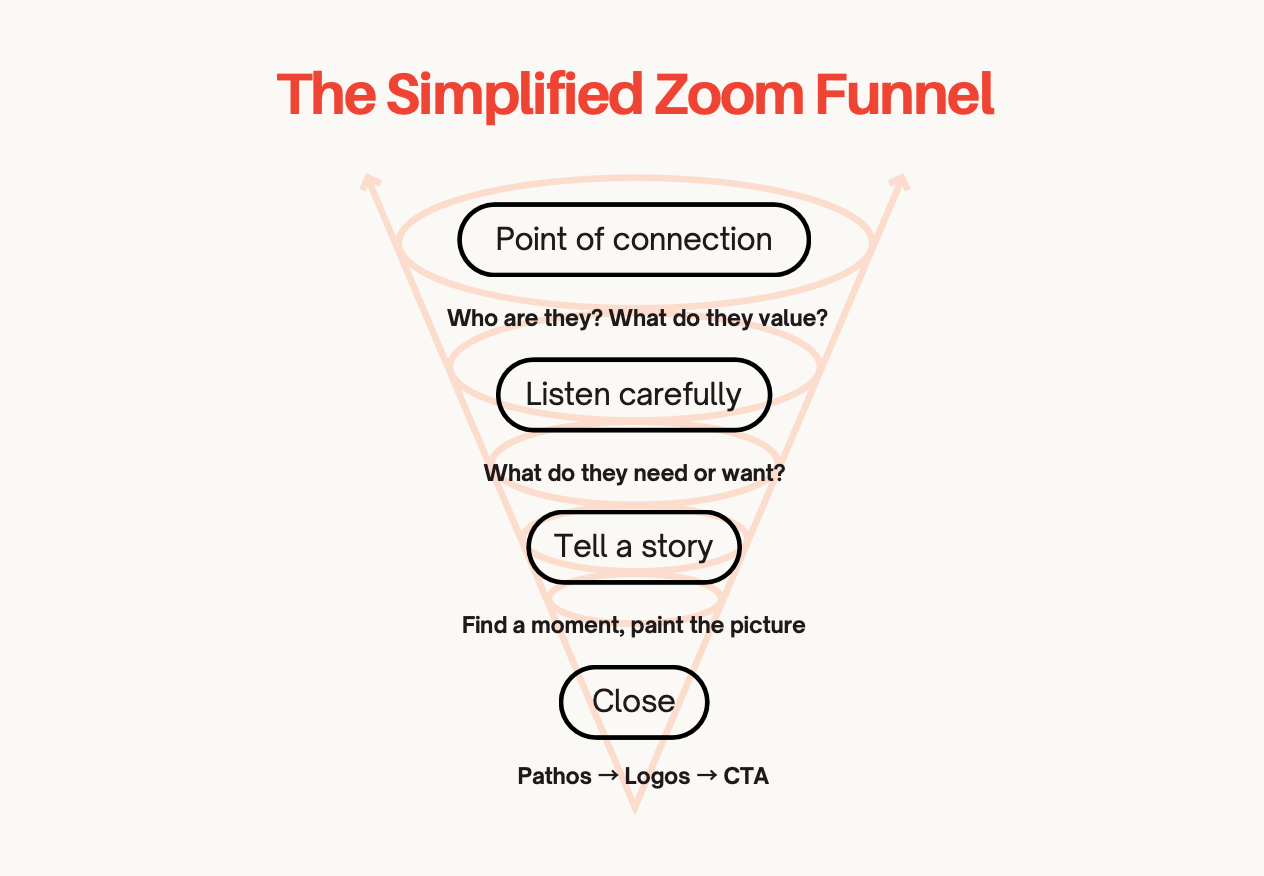
The Zoom Funnel: Connection Over Pitch
Here's what I've learned from raising millions of dollars: the person asking questions is in control of the conversation.
Most folks walk into these calls thinking they need to deliver a perfect pitch. But that approach almost always fails because it's transactional, not relational. More so, you’re taking from people, rather than giving. People invest in people they trust and stories they care about.
Here's a simplified framework that I teach in my Crowd-Equity Playbook:
1. Icebreaker & Listen (minutes 0–25)
Start light and human. I opened by mentioning the adorable dog photos all over her Instagram and email profile picture. She lit up and told me this whole story about adopting the dog from a film set years ago, and how she now watches that movie she produced every time she’s on the plane just to see the younger version of her dog.
That five-minute dog story built more trust than any “Sundance-winner” ever could… in my opinion.
Then I kept the spotlight on her. Asked about her work, passions, what she's looking for in projects. Let her talk. While she spoke, I listened for clues about what she valued – creative fulfillment? Financial returns? Legacy? The more they talk, the more you understand how to frame your story.
2. Tell a Story & Spin Your Pitch (minutes 25–35)
Eventually, she turned the conversation toward me. This is your moment – but don't "pitch." Tell a story.
I told her about returning to Korea with my dad, feeling like a stranger in a place that was supposed to be home, and realizing this film was the only way I could process those feelings.
Then I connected it to what she'd revealed earlier. She'd mentioned she values projects with clear marketing angles that create mystery for audiences. So I immediately related that to what I'd learned building my YouTube channel – where everything hinges on packaging that creates curiosity and sets expectations.
We were speaking the same language now.
3. Close Without Selling (minutes 50–60)
By the end, if you've done everything right, you shouldn't have to hard-sell. They're already invested — emotionally.
I never push. I hate being sold to, and I assume everyone else does too. So I just let the energy carry us to a natural close: "I'd love to send you the script when it's ready."
She asked to read it, meet my other producer, and check back in once we finalized the next draft. We ended singing to the “film gods” for a productive writing session.
The Bigger Lesson
Your job as a filmmaker isn't just to “make great art” – it's to communicate your vision clearly enough that other people want to help you bring it to life.
That means being a good conversationalist. Reading the room, listening actively, telling compelling stories, and connecting with people on a human level.
I used to be terrified of public speaking. My tongue still feels jumbled half the time. But I've practiced, and I've gotten better, and I refuse to let that weakness stop me from achieving what I want to achieve.
Practice like Steve Jobs (90+ hours rehearsing keynotes), but perform like Phil Knight selling shoes out of his car – raw, passionate, infectious.
Because people don't remember what you said. They remember how you made them feel.
Thanks for being here, and reading. Now go have some great conversations.
📌 Thomas’s Bookmarks
My favorite links of the week to help you be wiser and more creative.
“It took me 50+ years to realize what I’ll tell you in 69 minutes” - Tony Robbins - Completely changed my outlook on motivation and purpose. A multi-billionaire coaching a new billionaire, live.
James Cameron on his Key Principles to Success - A fascinating look into the minds of one of the greats. Say what you will about Avatar (I haven’t even seen the new one yet), but I’m always intrigued by the minds of hard-willed artists… and how they’ve found themselves over the years.
💾 Community Plugs
Resources for filmmakers, content creators, and industry professionals.
☀️ Attending Sundance or festivals this year? Let me know your favorite film that you’ve seen so far!
🎞️ Need a pitch deck for a short or feature? I created a comprehensive plug-and-play pitch deck template for independent filmmakers. Save time, win over producers and investors.
Want the full Zoom Funnel framework? The complete 7-step breakdown (with investor archetypes, objection handling, and more) is in The Ultimate Crowd-Equity Playbook (20% discount code at checkout with TIDBITS20).
🎬 Crowdfunding a short film? The Short Film Crowdfunding Playbook publicly releases next week — a step-by-step guide to raising funds outside your personal circles. Grab a discounted early-bird copy here.
📹 Behind the Scenes

Snowstorm in NYC! A bit underwhelming, but appreciated regardless. Now today, it’s just cold, wet, dirty slush. If you’re in the city, don’t forget your boots. :)
Thanks for reading! Consider subscribing if you haven’t already, and if you enjoyed this newsletter, please consider forwarding or sharing it to a friend!
Reply